The difference between synthetic vs natural sapphire is the single most important thing to understand before you spend money on a sapphire ring. Both are real sapphire in a chemical sense, yet one is worth many times the other, and most buyers cannot tell them apart. This guide explains exactly what separates them, how to spot the difference yourself, and what each is actually worth.
What synthetic and natural sapphire actually are
A natural sapphire forms over millions of years deep in the earth. It is a variety of the mineral corundum, coloured by trace elements, and it is mined from deposits in places like Sri Lanka, Myanmar, and Thailand. A synthetic sapphire is the same mineral grown in a laboratory in weeks rather than millennia, most commonly by a process called flame fusion.
This is the part that confuses people. In the synthetic vs natural sapphire debate, both stones are genuinely sapphire, sharing the same chemical makeup and hardness. The difference is not what they are made of but how they came to exist, and that difference is what the entire value gap rests on.
The real difference between them
The difference comes down to rarity and character. A natural sapphire is finite. There is only so much in the ground, each stone took an age to form, and no two are identical. A synthetic sapphire can be produced in unlimited quantity, which is exactly why it costs a fraction of the price.
The other difference is inside the stone. Natural sapphires carry tiny inclusions, the fingerprints left by the earth. Synthetic stones tend to be too clean, or carry telltale curved growth lines and gas bubbles natural stones never have. Those internal clues are the heart of the synthetic vs natural sapphire question.
| Feature |
Natural Sapphire |
Synthetic Sapphire |
| Origin |
Formed in the earth |
Grown in a lab |
| Inclusions |
Natural, irregular |
Too clean or curved lines |
| Rarity |
Finite and rare |
Unlimited supply |
| Value |
High, holds value |
Low, little resale |
| Hardness |
9 Mohs |
9 Mohs |
How to tell a sapphire is synthetic
When it comes to synthetic vs natural sapphire, the clearest sign is the inside of the stone. Look closely under good light, ideally with a jeweler’s loupe. A natural sapphire shows irregular natural inclusions, tiny crystals, or faint colour zoning. A synthetic sapphire is often flawless in a way that looks too perfect, or it shows curved growth lines rather than the angular features of a natural stone.
Price is the other giveaway. If a large, perfectly clean, vividly coloured sapphire is being sold cheaply, it is almost certainly synthetic. Natural stones of that quality are expensive precisely because they are rare. When something looks too good for the price, the answer to the synthetic vs natural sapphire question is usually synthetic.
Simple tests you can do at home
You cannot settle the synthetic vs natural sapphire question with total certainty at home, but a few checks point you in the right direction. Hold the stone to the light and look for inclusions. A completely flawless stone is a warning sign, not a good one, because natural sapphires almost always have some internal character.
Shine a flashlight through the stone. Natural sapphires often show uneven colour and natural zoning, while many synthetics glow with a single flat even colour throughout. Check the temperature too, since real sapphire stays cool against the skin for a moment. None of these is proof on its own, but together they tell you whether a stone deserves a closer look from a professional.
Can a jeweler tell the difference
Yes. A qualified jeweler or gemologist can almost always tell synthetic vs natural sapphire apart under magnification, because the internal growth features are different and visible to a trained eye. For absolute certainty, a gemological laboratory can confirm origin with specialised equipment.
This is why certification matters in any synthetic vs natural sapphire decision. A reputable seller of natural stones can provide a lab report on request. If a seller cannot or will not confirm whether a stone is natural, treat that as your answer.
What each one is worth
Value is where the synthetic vs natural sapphire gap is widest. A natural sapphire holds real and lasting value, and fine natural stones appreciate over time and a quality one carat natural sapphire runs from a few hundred dollars into the thousands depending on colour and clarity. The most valuable colour is a rich velvety blue, with Kashmir and Burmese origins commanding the highest prices.
A synthetic sapphire has very little resale value. A one carat synthetic stone costs only a few dollars to produce and sells cheaply, and a two carat lab grown sapphire is not worth dramatically more, because size is not rarity when a stone can be grown to order. Synthetic stones are fine as affordable decorative jewelry, but they are not an investment and will never carry the worth of a natural stone.
Buying with confidence
The honest truth is that no photograph settles the synthetic vs natural sapphire question on its own. What protects you is buying from a seller who states clearly that the stone is completely natural, not synthetic, not dyed, and not treated in any form, and who stands behind that claim.
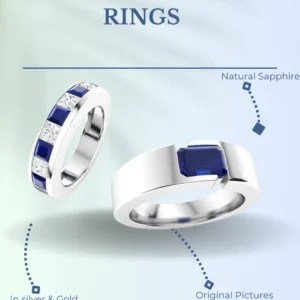
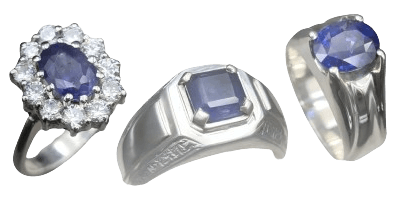
Every sapphire in our collection is a genuine natural stone in solid 925 sterling silver. Browse our natural sapphire rings collection, see our handcrafted sterling silver rings for men, or explore our natural ruby rings. To learn more about how sapphire is graded, see the International Gem Society guide to sapphire.
Frequently Asked Questions
How can you tell if a sapphire is synthetic or natural?
Look inside the stone under light. Natural sapphires show irregular natural inclusions and colour zoning, while synthetics are often too flawless or show curved growth lines and gas bubbles. A very low price on a large flawless stone is also a strong sign it is synthetic.
Can a jeweler tell if a sapphire is lab created?
Yes. A qualified jeweler or gemologist can almost always tell under magnification because the internal growth features differ. A gemological lab can confirm it with certainty, which is why a lab report is worth asking for.
How to tell if a sapphire is real with a flashlight?
Shine a flashlight through the stone. A natural sapphire often shows uneven colour and natural zoning, while many synthetic stones glow with a single flat even colour. This is a useful hint rather than proof on its own.
Are synthetic sapphires worth anything?
Very little. A synthetic sapphire costs only a few dollars to produce and has almost no resale value. It is fine as affordable decorative jewelry but is not an investment.
How much is a 1 carat natural sapphire worth?
A quality one carat natural sapphire runs from a few hundred dollars into the thousands depending on colour, clarity, and origin. A one carat synthetic sapphire, by contrast, sells for only a few dollars.
What color of sapphire is most expensive?
A rich velvety blue is the most prized and expensive colour, with Kashmir and Burmese origins commanding the highest prices. Padparadscha, a rare orange pink sapphire, is also extremely valuable.
How can I test a sapphire at home?
Look for natural inclusions under light, check that the stone stays cool to the touch for a moment, and be suspicious of a flawless stone at a low price. These checks point you in the right direction, though only a jeweler can confirm it for certain.