Are ring sizes universal? No. Different countries use different systems, so a size 7 in the United States is not a size 7 in Japan, and the UK uses letters instead of numbers. The good news is that every system measures the same finger, so converting is easy once you know the inside diameter or circumference. This guide shows you how.
Are Ring Sizes Universal
There is an international standard, ISO 8653, that defines ring size by inner circumference in millimetres. Many European countries use it directly, including Germany, France and Italy. The United States, Canada, the UK, Australia and Japan still use their own scales.
So are all ring sizes the same around the world? The finger is the same, but the label changes. That is why you should always check which system a seller uses before you order.
The Main Ring Size Systems
US ring size uses numbers from about 3 to 15, with half and quarter sizes. Each full size adds roughly 0.8 mm to the inside diameter.
UK ring size uses letters from A to Z, with half sizes such as N and a half. Australia and Ireland use the same letters.
EU ring size usually equals the inner circumference in millimetres, so a size 54 measures 54 mm around the inside. Japanese ring size uses its own numbers, which do not match US numbers.
Ring Size Conversion Chart
Here is a quick ring size conversion for the most common sizes. Small rounding differences exist between charts, so treat these as close matches.
| Size Match |
Inside Diameter |
| US 5, UK J and a half, EU 49 |
15.7 mm diameter |
| US 6, UK L and a half, EU 51.5 |
16.5 mm diameter |
| US 7, UK N and a half, EU 54 |
17.3 mm diameter |
| US 8, UK P and a half, EU 57 |
18.2 mm diameter |
| US 9, UK R and a half, EU 59.5 |
19.0 mm diameter |
| US 10, UK T and a half, EU 62 |
19.8 mm diameter |
When in doubt, convert using millimetres. The inside diameter or circumference is the one number every system agrees on.
Ordering a Ring From Another Country
Check the size system on the product page first. If it is not clear, message the seller with your inside diameter in millimetres and ask them to confirm.
If you are between sizes, choose the larger one for wide bands and the smaller one for slim bands. Ask whether the ring can be resized, and at what cost.
Measure accurately with our guide to measuring ring size at home, read are mens and womens ring sizes the same, or browse our natural gemstone rings shop.
Shop Gemstone Rings →
For the history and range of ring styles worldwide, see the Britannica entry on rings.
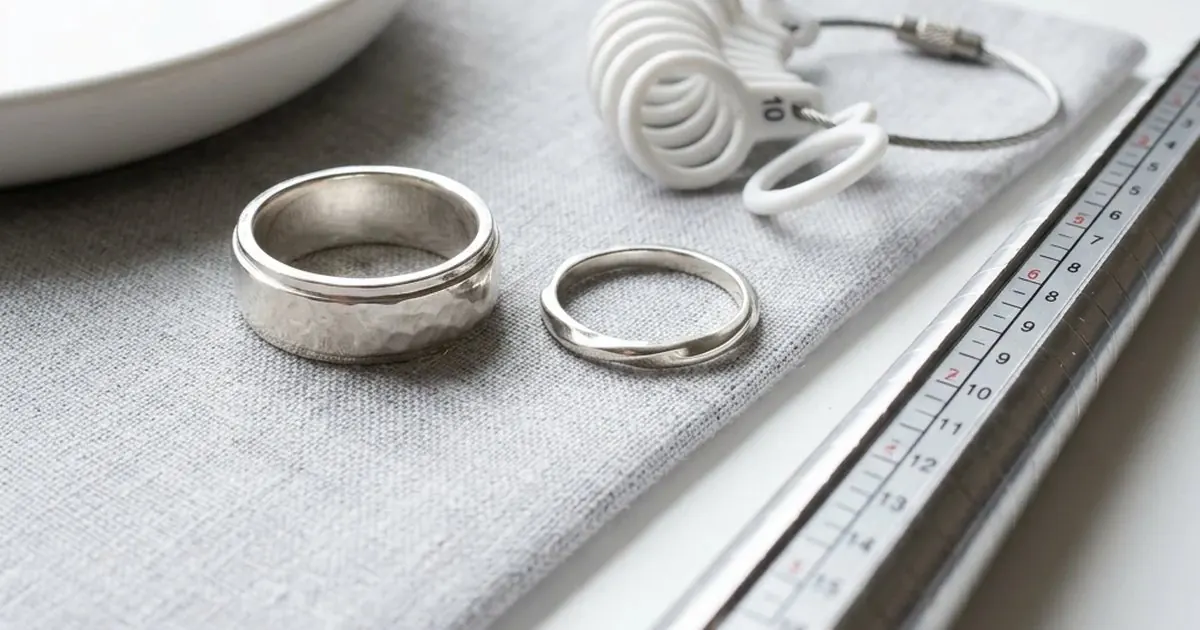
A plastic ring sizer strap, a set of metal finger gauges or a ring mandrel will give a reliable reading. Printable sizers work in a pinch if you print at 100 percent scale.
Most online shops also publish a ring size chart on the product page. Check it carefully, because a few brands run slightly large or small.
You can also measure a ring that already fits. Measure the inside diameter across the widest point and match it to the chart above.
The Bottom Line
Are ring sizes universal? Not by label, but yes by measurement. Know your size in millimetres and you can order confidently from any country.
Keep a note of your size in US, UK and EU terms on your phone. It saves time whenever you shop online.
Remember that fingers change with temperature, time of day and even travel. Hands swell in heat and on long flights, and shrink in the cold. If a ring feels tight on holiday, wait a day before deciding it is the wrong size. A size that fits well in the evening at home is usually the right one to order.
Quick FAQ
Is a US size 7 the same as a UK size 7?
No. The UK uses letters, and a US 7 is close to a UK N and a half.
What ring size system does Europe use?
Most of Europe uses the inner circumference in millimetres, such as size 54.
Are ring sizes universal for men and women?
Within one country, yes. Men and women share the same scale.
How do I convert my ring size?
Find your inside diameter or circumference in millimetres, then match it on a conversion chart.
Are Japanese ring sizes the same as US sizes?
No. Japan uses its own number scale, so always convert by millimetres.