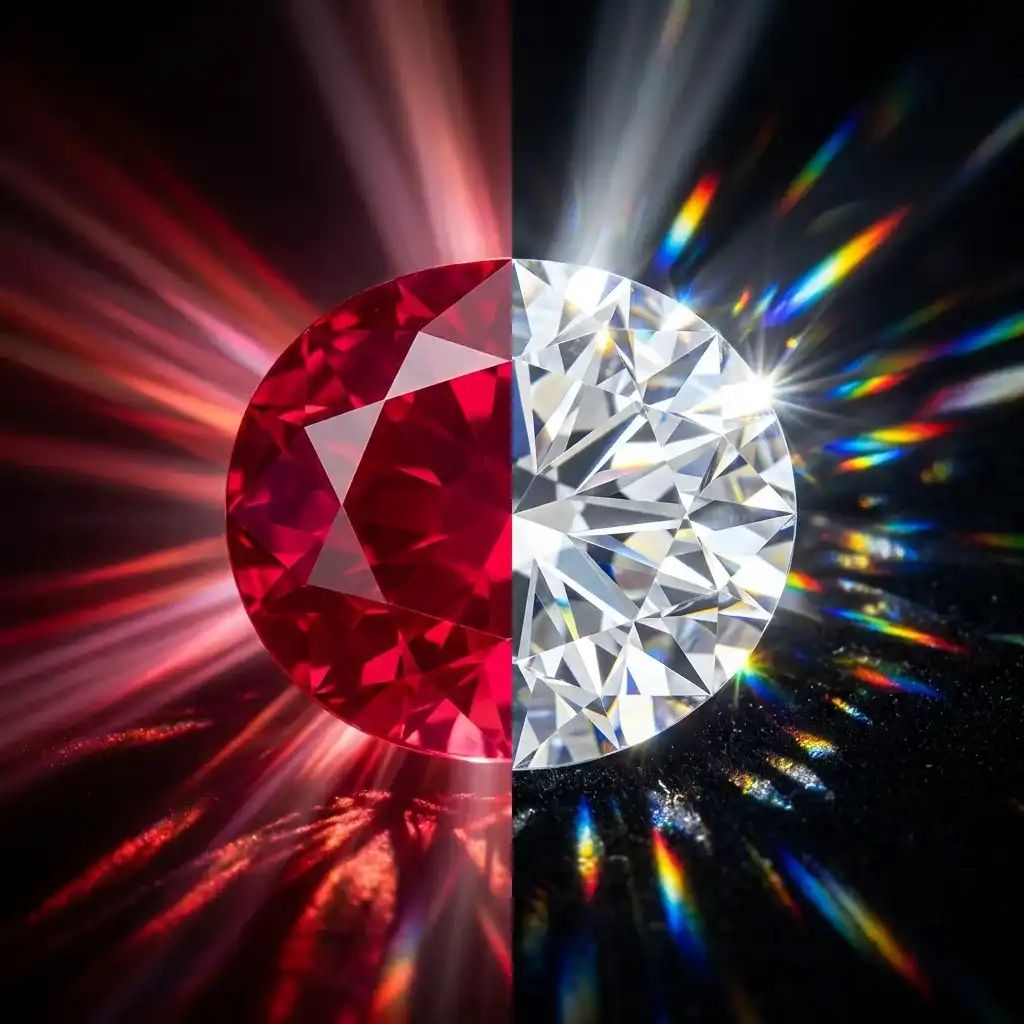
Ruby vs diamond is the comparison every serious gemstone buyer eventually faces. Both stones carry enormous cultural weight, both appear at the top of every precious stone ranking, and both command prices that can reach millions of dollars per carat at auction. But they are fundamentally different in what they offer, how they perform, and what they mean. This ruby vs diamond breakdown covers every factor that matters to a buyer making a real decision.
Diamond is pure carbon, the hardest natural substance on earth. Ruby is corundum, a crystalline aluminium oxide colored red by trace amounts of chromium. In the ruby vs diamond comparison the mineral difference matters because it shapes every other characteristic, from hardness to light behavior to rarity. Diamond forms under extreme pressure deep within the Earth’s mantle. Ruby forms in metamorphic and igneous rock under different conditions, in marble deposits and basalt flows across Myanmar, Mozambique, Thailand, and a handful of other locations. They share almost nothing at the molecular level beyond being natural stones pulled from the ground.
Diamond scores Mohs 10, the maximum possible hardness, meaning nothing in nature scratches it. Ruby scores Mohs 9, placing it second among natural gemstones. In practical terms this makes ruby an exceptionally durable stone for daily wear, far tougher than emerald, opal, or turquoise. The one point difference between ruby vs diamond on the Mohs scale understates the real gap. The Mohs scale is not linear and diamond is actually many times harder than corundum at Mohs 9. For everyday jewelry the difference is largely academic since ruby handles rings, bracelets, and pendants without issue, but for extreme wear scenarios diamond has a clear edge.
This is where ruby vs diamond diverges most visibly. Diamond is cut to maximize brilliance, the reflection of white light, and fire, the dispersion of that light into rainbow colors. A well-cut diamond in direct light is almost aggressively bright. Ruby is cut entirely differently. The goal with ruby is to maximize the depth and saturation of the stone’s internal red glow, not to scatter light. A fine ruby does not compete with diamond on sparkle. It wins on presence, on the way a deep pigeon blood red stone commands attention without movement or direct light. Both are beautiful for entirely different reasons and choosing between them is ultimately a choice between two different visual philosophies.
Fine ruby is significantly rarer than diamond at the top of the market. This surprises most buyers who assume diamonds are rare because of their price and marketing. The diamond industry produces hundreds of millions of carats annually from mines across Russia, Botswana, Canada, and Australia. Fine ruby, specifically the unheated pigeon blood material from Myanmar’s Mogok Valley, is produced in tiny quantities and has been largely exhausted from its most productive historical deposits. According to GIA, a fine unheated ruby with strong color and acceptable clarity is among the rarest objects sold at auction. The top 5 most expensive gemstones per carat sold at auction in recent decades include multiple rubies.
At the fine grade, ruby vs diamond is not a close contest on price. The most expensive ruby ever sold at auction reached over $1 million per carat, a figure that exceeds all but the rarest pink and red diamonds. A 1 carat commercial-grade ruby in silver jewelry costs $200 to $600. A fine unheated Burmese ruby of 1 carat with GIA certification starts at $10,000 and reaches $30,000 or beyond. A $1,000 diamond at commercial grade buys approximately 0.3 to 0.5 carats depending on cut and clarity. A $1,000 ruby at commercial grade buys a similar carat range but with far greater potential for appreciation at the fine grade. What is more expensive than a diamond at the highest quality levels? Fine ruby, Kashmir sapphire, alexandrite, and a handful of other colored stones that most buyers never encounter at retail.
Ruby holds one of the strongest positions of any gemstone in religious literature. In Proverbs 31:10 a virtuous woman is described as worth far more than rubies, placing the stone at the apex of earthly value in ancient Hebrew culture. Ruby also appears in descriptions of the High Priest’s breastplate in Exodus and in the book of Job where wisdom is described as beyond the price of rubies. In Islamic tradition no stone carries a prohibition and gemstones including those in red tones have a long recorded history in Islamic royal jewelry and personal adornment. Diamond by contrast carries relatively little scriptural weight compared to ruby across multiple traditions.
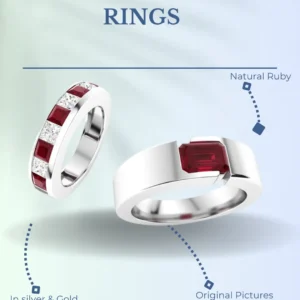
In Vedic astrology ruby represents the Sun and carries specific wearing restrictions. Taurus, Virgo, Capricorn, Aquarius, and Libra ascendants are traditionally advised against wearing ruby because the Sun is considered incompatible with their ruling planets. The rules for wearing ruby in this tradition include setting the stone in gold, wearing it on the ring finger of the right hand, and beginning on a Sunday morning after purification. In Islamic tradition there is no such restriction. Diamond in Vedic astrology represents Venus and carries its own set of compatibility guidelines, with Aries and Scorpio ascendants traditionally advised to consult an astrologer before wearing it. Browse the full natural ruby ring collection at RingsWear, all stones earth-mined and available with certification on demand.
| Factor | Ruby | Diamond |
|---|---|---|
| Mineral | Corundum | Carbon |
| Mohs Hardness | 9 | 10 |
| Visual Appeal | Deep red internal glow | White light brilliance and fire |
| Best Origin | Burma (Myanmar) | Botswana, Russia, Canada |
| 1 Carat Commercial | $200 to $600 | $1,500 to $5,000+ |
| 1 Carat Fine Grade | $10,000 to $1M+ | $5,000 to $30,000+ |
| Rarity (fine grade) | Rarer | More accessible |
| Scripture Significance | High (Proverbs, Exodus, Job) | Low |
| Daily Wear | Excellent | Excellent |
| Vedic Planet | Sun | Venus |
The ruby vs diamond decision is not about which stone is objectively better. It is about what you want the stone to do. Diamond offers unmatched hardness, colorless versatility, and maximum sparkle. Ruby offers rarer material at the fine grade, deeper cultural and scriptural meaning, and a visual presence that no diamond can replicate. Both belong to the top tier of the gemstone world and both hold their value across generations when purchased at quality grades with proper certification.
Neither is objectively better. Diamond wins on hardness, sparkle, and commercial availability. Ruby wins on rarity at the fine grade, cultural depth, and the unique visual quality of its deep red color. The right choice depends entirely on what the buyer values.
At commercial grades, a 1 carat diamond typically costs more than a 1 carat ruby. At fine grades the situation reverses. A top Burmese ruby with GIA certification commands higher prices per carat than any comparable white diamond. The ruby vs diamond price comparison depends entirely on quality tier.
At the highest quality levels, yes. Fine unheated Burmese ruby has set per-carat auction records that exceed white diamond prices. For investment-grade material, fine ruby represents one of the rarest and most consistently appreciating colored gemstones in the world.
A commercial-grade 1 carat ruby costs $200 to $600. A fine unheated Burmese ruby of 1 carat with strong pigeon blood color and GIA certification starts at $10,000 and can exceed $30,000 depending on saturation, clarity, and origin documentation.
The term most commonly refers to white topaz, cubic zirconia, or moissanite, which are colorless stones used as diamond substitutes at significantly lower price points. It does not refer to ruby, which in its finest form is actually more expensive per carat than diamond.
Painite held that title for decades with only a handful of known specimens. Musgravite, red beryl, and grandidierite are also among the rarest. Fine Burmese ruby is the rarest commercially traded gemstone at significant scale, meaning it is actively bought and sold at auction rather than existing only in museum collections.
Among commercially relevant stones: fine Burmese ruby, Kashmir sapphire, and Colombian emerald of top quality are the rarest actively traded precious gemstones. Among minerals overall, painite, musgravite, and red beryl are rarer but rarely appear in jewelry.
The traditional four precious stones are diamond, ruby, emerald, and sapphire. All other gemstones are classified as semi-precious. Ruby, emerald, and sapphire together form the big 3 colored precious stones, with diamond standing apart as the colorless standard.
By per-carat auction records: pink diamond, red diamond, Burmese ruby, blue diamond, and Kashmir sapphire. Fine ruby consistently appears among the top three most expensive gemstones ever sold per carat, placing it firmly above standard white diamond in the ruby vs diamond price debate at the investment level.
At the finest grades: red diamonds, pink diamonds, fine Burmese ruby, Kashmir sapphire, alexandrite, and padparadscha sapphire all command higher per-carat prices than white diamonds of comparable quality. Fine ruby is the most commercially significant stone that regularly exceeds white diamond pricing.
At $1,000, a commercial-grade white diamond typically yields 0.25 to 0.40 carats depending on cut, color, and clarity. A $1,000 commercial-grade ruby buys a similar carat range, but the potential price ceiling for exceptional ruby material far exceeds what an equivalent dollar amount in diamond can achieve.
In Vedic astrology, Taurus, Virgo, Capricorn, Aquarius, and Libra ascendants are traditionally advised against wearing ruby as it represents the Sun, which conflicts with their ruling planets. In Islamic tradition there is no prohibition and ruby has no restriction attached to it for any wearer.
Yes. A certified gemologist uses magnification to examine natural inclusion patterns, a refractometer to measure the refractive index, and spectroscopy to detect heat treatment or synthetic origin. Glass-filled rubies and synthetic corundum have specific optical signatures that trained professionals identify under examination. A GIA certificate is the most reliable authentication for any significant ruby purchase.
Ruby is referenced multiple times in the Bible. Proverbs 31:10 places its value above that of a virtuous woman as a metaphor for supreme worth. Job 28:18 states that wisdom cannot be priced in rubies. Exodus references ruby among the twelve stones of the High Priest’s breastplate. Across the Old Testament, ruby consistently represents the highest tier of earthly value and beauty.
Can men wear ruby ring styles the way women do? Yes, and they have for...
Choosing the right yellow sapphire ring finger is the first question most people ask once...

Knowing how to clean amethyst ring at home keeps the purple bright and the silver...

The Yemeni aqeeq gemstone in Islam holds a place few other stones can claim. Worn...

The difference between synthetic vs natural sapphire is the single most important thing to understand...

Yellow sapphire rings for men are among the most meaningful pieces a man can own....
Real gemstone rings in 925 silver are one of the smartest purchases a man can...
Why do shias wear aqeeq rings? Walk into any gathering in Iran, Iraq, Pakistan or...
The question of whether wearing an aqeeq ring sunnah is a real practice comes up...