Table of Contents
Ruby vs sapphire is one of those debates that sounds simple until you start digging. Both stones share the same mineral family, both sit among the big 3 precious gems alongside emerald, and both have commanded extraordinary prices at auction. Yet buyers consistently ask the same questions: which one is harder, which one costs more, and which one is actually worth buying. This guide covers every real difference between ruby vs sapphire so you can make a decision based on facts rather than marketing.
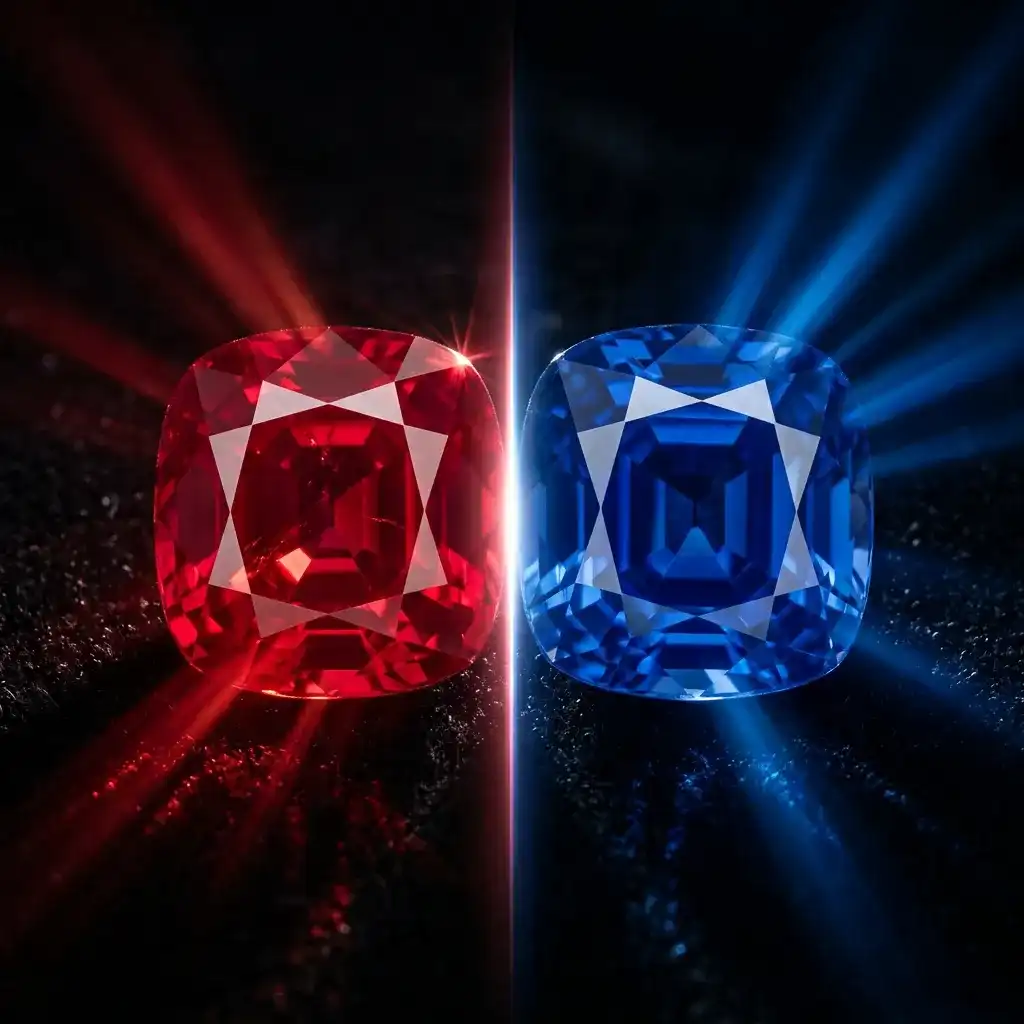
The most important thing to understand about ruby vs sapphire is that they are technically the same mineral. Both are varieties of corundum, a crystalline form of aluminium oxide. What separates them is trace elements. Chromium gives ruby its red color. Iron and titanium give blue sapphire its distinctive hue. A pink corundum sits in a disputed zone between the two, with some gemologists classifying pale stones as pink sapphire and deeper ones as ruby depending on color saturation standards that vary by country. According to GIA, the red color threshold that separates ruby from pink sapphire is one of the most debated classifications in the gemstone industry.
When it comes to ruby vs sapphire durability, the result is essentially a draw. Both stones score Mohs 9, making them the second hardest natural gemstones after diamond. Neither scratches easily under daily wear and both handle physical impact far better than softer stones like emerald or opal. The practical difference is negligible for a buyer choosing between the two purely on durability grounds. Both are excellent choices for everyday wear in a ring, bracelet, or pendant. Ruby is not stronger than sapphire in any meaningful sense, and sapphire is not more durable than ruby. They are equals on every hardness and toughness measure that matters to a buyer.
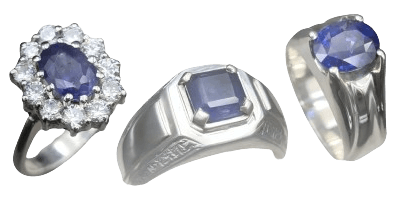
Color is where ruby vs sapphire diverges completely. The finest ruby displays pigeon blood red, a vivid pure red with a slight blue undertone found almost exclusively in stones from Myanmar. The finest blue sapphire shows a deep, velvety cornflower blue with no gray or green undertone, historically associated with Kashmir origin. Both stones are color-graded by saturation, hue, and tone, and in both cases the finest specimens command premiums that bear no relationship to commercial-grade pricing. Sapphire also comes in yellow, pink, orange, green, and the extremely rare padparadscha, an orange-pink variety from Sri Lanka that approaches fine ruby in price per carat.
Fine-quality ruby is significantly more expensive than fine blue sapphire. This is the clearest answer in the entire ruby vs sapphire debate. Fine ruby is rarer at the top end of the market, and Burmese pigeon blood rubies regularly set per-carat records at auction that no blue sapphire can match outside of Kashmir origin stones.
A 1 carat ruby of commercial quality costs roughly $200 to $600 depending on color and clarity. A fine unheated Burmese ruby of 1 carat can reach $10,000 to $30,000 or beyond with GIA certification. A 1 carat blue sapphire of commercial quality starts around $100 to $400. A fine unheated Ceylon or Kashmir sapphire of 1 carat ranges from $3,000 to $15,000 depending on origin and saturation. Only Kashmir sapphire and padparadscha sapphire approach fine ruby pricing, and both are exceptionally rare in their own right. At the fine end, ruby vs sapphire is not a close contest on price.
As for whether sapphire and ruby are more expensive than diamond, the answer is yes at the very top of the market. A fine Burmese ruby or Kashmir sapphire per carat can outprice a comparable diamond significantly. At commercial grades, both colored stones are generally more affordable than diamonds of similar carat weight.
The easiest way to tell ruby vs sapphire apart is color. Ruby is red. Sapphire is most commonly blue, though it comes in every color except red, which is by definition ruby. Where things get complicated is in the pink-to-red zone. A pale pinkish red stone might be classified as pink sapphire in one country and ruby in another depending on the grading standard applied.
A trained jeweler can confirm ruby vs sapphire identification through a combination of spectroscopy, which detects the trace elements causing the color, and magnification to examine the inclusion fingerprint specific to each variety and origin. A gemological certificate from GIA or an equivalent laboratory removes any doubt and is the only reliable way to confirm both identity and treatment status for a serious purchase.
In Vedic astrology the ruby vs sapphire distinction carries significant weight because the two stones represent opposing planetary forces. Ruby represents the Sun and blue sapphire represents Saturn, which are considered natural enemies in Jyotish tradition. Wearing both together is strongly advised against in this system. Ruby is traditionally avoided by Taurus, Virgo, Capricorn, Aquarius, and Libra ascendants. Blue sapphire is traditionally avoided by Aries, Cancer, Leo, Scorpio, and Pisces ascendants. The rules for wearing ruby specifically include wearing it on the ring finger of the right hand on a Sunday morning after purification. In Islamic tradition neither stone carries any prohibition and both have a long recorded history in Islamic jewelry and royal courts.
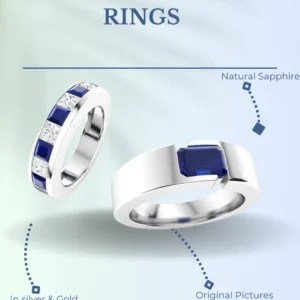
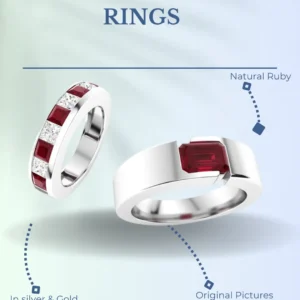
Ruby is the birthstone for July and is most associated with Leo in Western astrology, where it is considered the power stone of the sign. Sapphire is the birthstone for September and is associated with Virgo and Libra. Both stones have strong birthstone gifting markets and perform well as anniversary and milestone gifts regardless of the recipient’s birth month. You can find both stones set in solid 925 sterling silver in the ruby ring collection and the sapphire ring collection at RingsWear.
| Factor | Ruby | Sapphire |
|---|---|---|
| Mineral Family | Corundum | Corundum |
| Mohs Hardness | 9 | 9 |
| Color | Red (pigeon blood = finest) | Blue, yellow, pink, padparadscha |
| Best Origin | Burma (Myanmar) | Kashmir, Ceylon (Sri Lanka) |
| 1 Carat Commercial | $200 to $600 | $100 to $400 |
| 1 Carat Fine Grade | $10,000 to $30,000+ | $3,000 to $15,000+ |
| Rarity (fine grade) | Rarer | More accessible |
| Daily Wear | Excellent | Excellent |
| Birthstone Month | July | September |
| Vedic Planet | Sun | Saturn |
The ruby vs sapphire debate ultimately comes down to what you value most. If price ceiling and rarity at the fine grade matter, ruby wins. If color variety and accessibility matter, sapphire wins. Both are equal on durability and both are exceptional choices for a natural gemstone that will last a lifetime. Browse the full natural gemstone ring collection at RingsWear to see both stones in handcrafted 925 sterling silver settings.
No. Fine ruby is significantly more expensive than fine sapphire at every quality tier. Only Kashmir sapphire and padparadscha sapphire approach fine Burmese ruby pricing. At commercial grades the price difference is smaller but ruby vs sapphire still favors ruby at equivalent quality.
Neither is objectively better. Ruby wins on price ceiling and rarity at the fine grade. Sapphire wins on color variety and availability. On durability they are identical at Mohs 9. The choice depends entirely on which color and budget range works for the buyer.
They are equally durable. Both score Mohs 9 and belong to the same corundum mineral family. Ruby is not stronger than sapphire and sapphire is not tougher than ruby. Both are excellent for daily wear in any jewelry setting.
Color is the primary identifier. Ruby is red. Sapphire covers every other color of corundum. In borderline pink-red cases, a certified gemologist uses spectroscopy and magnification to confirm the classification. A GIA certificate is the most reliable way to confirm identity and treatment history for any significant purchase.
A commercial-grade 1 carat ruby costs $200 to $600. A fine unheated Burmese ruby of 1 carat with GIA certification can reach $10,000 to $30,000 or more depending on color saturation and inclusion grade.
A commercial-grade 1 carat blue sapphire starts around $100 to $400. A fine unheated Ceylon or Kashmir sapphire of 1 carat ranges from $3,000 to $15,000 depending on origin, color depth, and certification.
At the very top of the market, yes. A fine Burmese ruby or Kashmir sapphire per carat regularly exceeds diamond prices at equivalent grades. At commercial quality levels, both colored stones are typically more affordable than diamonds of similar carat weight.
In price and rarity at the fine grade, yes. In hardness they are identical. In cultural status, ruby has historically been called the king of gemstones. Whether ruby is higher depends entirely on the metric being measured.
In Vedic astrology, ruby is traditionally avoided by Taurus, Virgo, Capricorn, Aquarius, and Libra ascendants as it represents the Sun, which conflicts with their ruling planets. In Islamic tradition there is no restriction on wearing ruby and the stone has no prohibition attached to it.
In Vedic astrology, blue sapphire represents Saturn and is traditionally avoided by Aries, Cancer, Leo, Scorpio, and Pisces ascendants. It is considered one of the most powerful and fast-acting stones in Jyotish, which is why consultation with an astrologer is typically recommended before wearing it.
Taurus, Virgo, Capricorn, Aquarius, and Libra ascendants are traditionally advised against wearing ruby in Vedic astrology. These signs are ruled by planets considered incompatible with the Sun, which ruby represents.
Ruby is the birthstone for July. It is associated with Leo in Western astrology and is considered the power stone for that sign. Sapphire is the birthstone for September and is associated with Virgo and Libra.
In Vedic tradition, ruby is worn on the ring finger of the right hand, set in gold, on a Sunday morning after purification and prayer. The stone should be at least 3 carats for astrological effect. These rules apply to intentional astrological use. For buyers wearing ruby purely for its beauty there are no rules beyond choosing a naturally sourced, untreated stone where possible.
In Vedic astrology, ruby and blue sapphire are the classic example of gemstones that should not be worn together. Ruby represents the Sun and blue sapphire represents Saturn, which are natural enemies in Jyotish. Diamond and ruby are another commonly cited incompatible pairing in the same system.
Yes. A trained gemologist uses magnification to examine natural inclusion patterns, a refractometer to measure light bending, and spectroscopy to detect heat treatment or synthetic origin. Synthetic rubies and glass-filled stones have specific visual and optical signatures that a professional identifies readily.
Yes. The same combination of magnification, refractometry, and spectroscopy used for ruby authentication applies to sapphire. Heat treatment, which is extremely common in commercial sapphire, also leaves detectable traces in the stone’s inclusion structure that a certified gemologist can identify and that a GIA report will disclose.
Can men wear ruby ring styles the way women do? Yes, and they have for...
Choosing the right yellow sapphire ring finger is the first question most people ask once...

Knowing how to clean amethyst ring at home keeps the purple bright and the silver...

The Yemeni aqeeq gemstone in Islam holds a place few other stones can claim. Worn...

The difference between synthetic vs natural sapphire is the single most important thing to understand...

Yellow sapphire rings for men are among the most meaningful pieces a man can own....
Real gemstone rings in 925 silver are one of the smartest purchases a man can...
Why do shias wear aqeeq rings? Walk into any gathering in Iran, Iraq, Pakistan or...
The question of whether wearing an aqeeq ring sunnah is a real practice comes up...